Williams %R
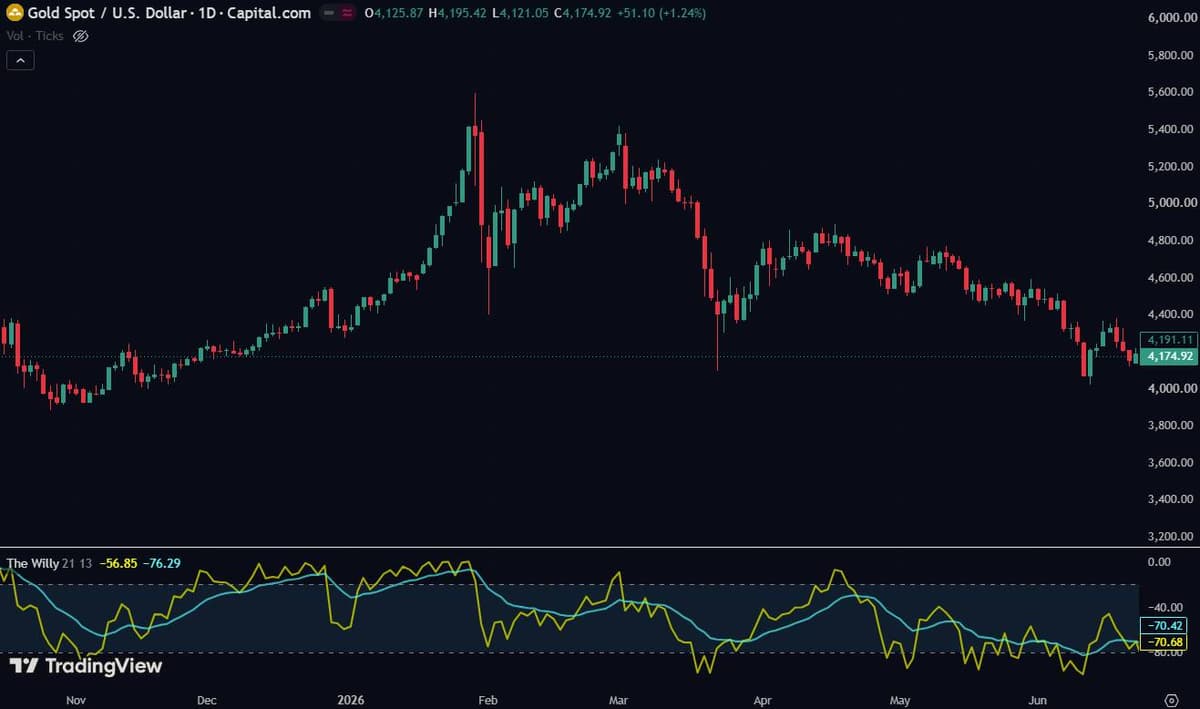
The Williams %R (Williams Percent Range) is a momentum oscillator developed by Larry Williams to measure where the latest closing price sits within the recent high-low trading range. It helps traders identify overbought and oversold market conditions, spot potential reversals, and evaluate short-term momentum.
Unlike many oscillators, Williams %R uses a scale from 0 to -100, making it easy to recognize when buyers or sellers may be losing strength. Although it is most effective in ranging markets, experienced traders often combine it with trend analysis, support and resistance, and moving averages to improve signal quality.
Whether you trade forex, stocks, indices, or cryptocurrencies, Williams %R can become a valuable confirmation tool when used alongside price action rather than as a standalone indicator.
Formula
Measures where the current close sits within the recent high-low range.
Near 0: Price closes near the period's highest high.
Near -100: Price closes near the period's lowest low.
Signal Speed
A fast momentum oscillator that reacts quickly to price changes.
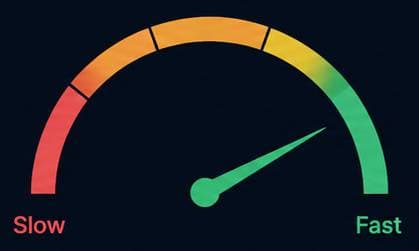
Williams %R reacts faster than many oscillators, producing earlier signals.
Faster signals can also mean more false signals. Always confirm.
Best Timeframes
Works across all timeframes. Choose based on your trading style.
Higher timeframes filter market noise and generally provide more reliable signals.
How Williams %R Works
Williams %R compares the current close with the highest high and lowest low over a specific lookback period—14 periods by default. A close near the range high pushes %R toward 0; a close near the range low pushes it toward -100.
Williams %R formula
%R = (Highest High - Close) ÷ (Highest High - Lowest Low) × -100
How to Read Williams %R
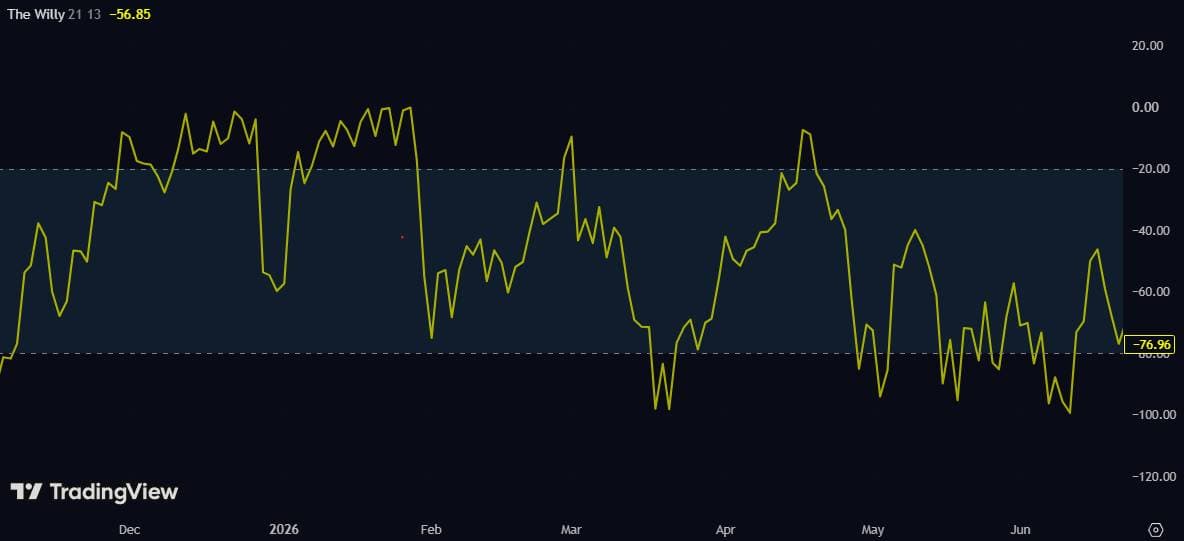
Williams %R moves between 0 and -100. It shows where the current close is located within the recent high-low range. Use the key levels below to identify potential reversals and momentum shifts.
Pro Tip
Williams %R works best with trend, support/resistance, and candlestick confirmation.
Overbought Zone
Above -20When Williams %R rises above -20, the closing price is near the highest level of the selected period. This indicates strong bullish momentum, but markets can remain overbought during powerful trends. Wait for bearish confirmation before considering a reversal trade.
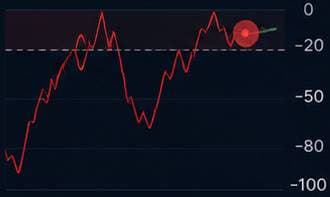
Watch for bearish divergence, resistance rejection, or a confirmed break below -20.
Oversold Zone
Below -80When Williams %R falls below -80, the closing price is near the lowest level of the selected period. This reflects strong selling pressure, but oversold conditions may continue in a downtrend. Wait for bullish confirmation before entering long positions.
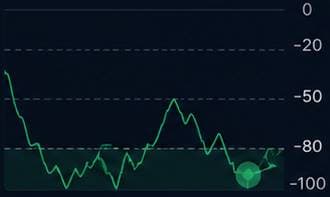
Watch for bullish divergence, support reactions, or a confirmed move back above -80.
Centerline
Around -50The -50 level separates bullish and bearish momentum. Readings above -50 suggest buyers are gaining strength, while readings below -50 indicate sellers remain in control.Combine this level with trend direction for more reliable analysis.
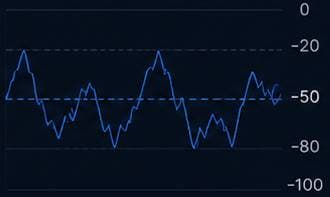
Use the centerline to confirm momentum direction instead of predicting reversals.
Momentum Shift
Crossing key levelsMomentum shifts occur when Williams %R crosses back above -80 or below -20 after reaching an extreme zone. These crossovers often signal changing market sentiment but should always be confirmed with price action and volume.
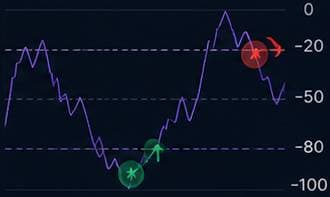
Look for candle confirmation before acting on any Williams %R crossover.
Key Takeaway
Williams %R is most effective when combined with market structure. Extreme readings highlight potential reversal zones, while the -50 centerline helps confirm momentum. Always validate signals with price action, trend direction, and volume before entering a trade.
How to Trade with Williams %R
Long entry
In an uptrend, wait for Williams %R to drop below -80, then cross back above -80. Enter long after price shows bulish confirmation (e.g., bullish candle, support bounce).
Short entry
In a downtrend, wait for Williams %R to rise above -20, then cross back below -20. Enter short after price shows bearish confirmation (e.g., bearish candle, resistance rejection).
Stop loss
Place the stop loss beyond the setup's recent swing low(for long) or swing high (for short). Never set stops based on %R levels.
Confirmation
Always confirm with market structure, trend direction, support/resistance, candlestick patterns, or volume before entering.
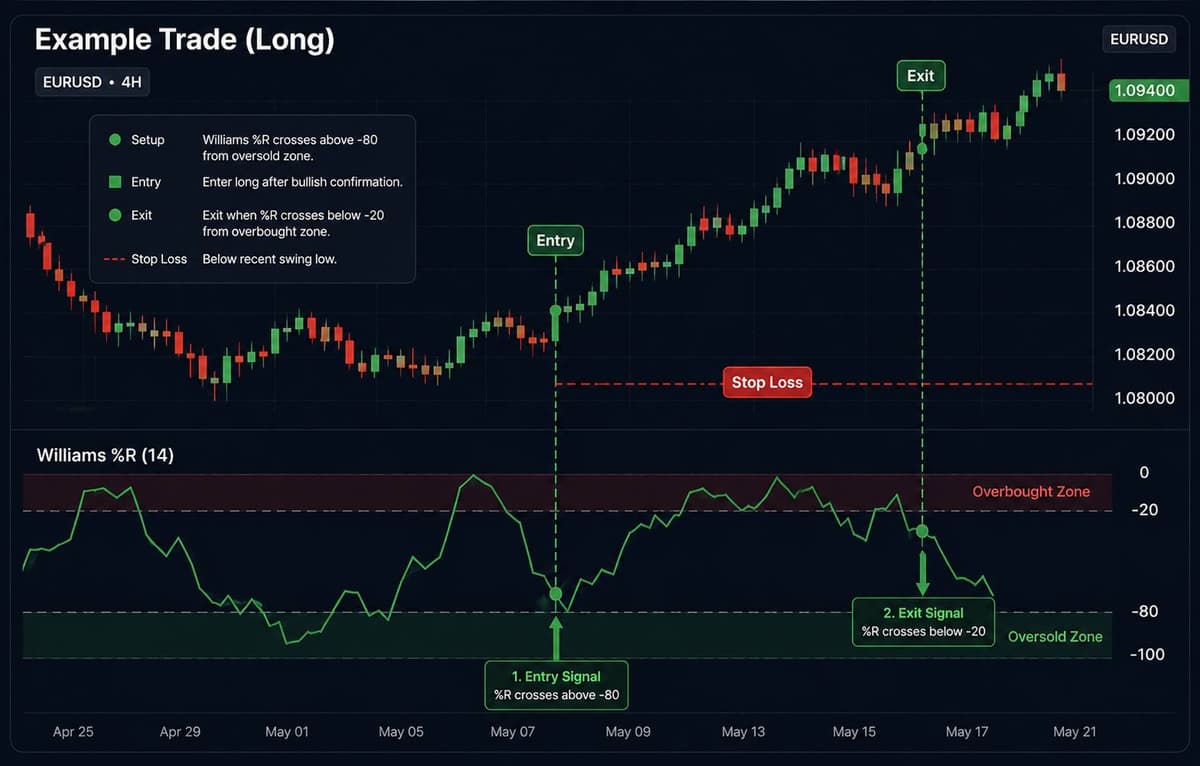
| Trend | Bullish (higher highs, higher lows) |
| Trigger | Williams %R crosses drop below -80 |
| Entry | %R crosses back above -80 with bulish confirmation |
| Stop Loss | After confirmation candle closes |
| Target | Next resistance level or 1:2 risk/reward |
Trade checklist
Trend is in the direction of the trade
Williams %R signal occurs at an extreme level
Price shows confirmation (candle or structure)
Near key support/resistance or confluence zone
Stop loss is placed beyond recent swing
Risk/reward ratio of at least 1:2`
No major news events affecting the market
Williams %R Strategy Combinations
Williams %R + EMA
Use the EMA to identify the market trend and Williams %R to find pullback entries. Take long trades above the EMA and short trades below it to filter weak reversal signals.
Williams %R + RSI
Combine Williams %R with RSI to confirm overbought, oversold, and divergence signals. When both indicators agree, the probability of a high-quality trade setup generally improves.
Williams %R + MACD
Use MACD to confirm the overall trend while Williams %R pinpoints entry timing. This combination helps reduce false reversals and improves confidence during pullbacks.
Support & Resistance
Focus on Williams %R signals that appear near major support or resistance levels. Combining momentum with price structure produces more reliable reversal setups than using the indicator alone.
Advantages vs Limitations
Advantages
- •Quickly highlights price-range extremes
- •Easy-to-read 0 to -100 scale
- •Useful for pullback and reversal timing
- •Works across markets and timeframes
- •Simple enough for newer traders
Limitations
- •Can generate false signals in strong trends
- •Can remain overbought or oversold for long periods
- •Reacts to past price data and may lag turning points
- •Needs confirmation from context or other tools
- •Should not be used as a standalone system
Best Williams %R Settings
The default 14-period setting works well for most traders. Faster settings generate earlier signals with more noise, while longer periods produce smoother, more reliable momentum readings. Choose the period that matches your trading style and timeframe.
Scalping
Period: 7
Chart: 1m-15m
Intraday
Period: 9-14
Chart: 15m-1H
Swing trading
Period: 14
Chart: 4H-1D
Crypto
Period: 14-21
Chart: 1H-4H
Position trading
Period: 21
Chart: 1D-1W
Common Williams %R Mistakes
Trading every signal
Not every overbought or oversold reading results in a reversal. Always wait for confirmation from price action, trend direction, or candlestick patterns before entering.
Ignoring the trend
Williams %R is more reliable when traded in the direction of the prevailing trend. Counter-trend signals are generally less dependable and carry greater risk.
Using %R alone
Avoid making trading decisions using only one indicator. Combine Williams %R with support and resistance, moving averages, or volume for stronger confirmation.
Wrong timeframe
Indicator performance depends on the chart interval. Select a timeframe that matches your trading style instead of using the same settings for every market.
Frequently Asked Questions
What is the Williams %R indicator?+
The Williams %R (Williams Percent Range) is a momentum oscillator developed by Larry Williams that measures where the latest closing price sits within the highest high and lowest low over a selected period. It fluctuates between 0 and -100, helping traders identify overbought and oversold conditions. A reading above -20 suggests the market is overbought, while a reading below -80 indicates oversold conditions. Traders commonly use Williams %R to identify potential reversal zones, confirm momentum shifts, and improve trade timing when combined with trend analysis and price action.
How do you read the Williams %R indicator?+
Williams %R is interpreted using three key areas: overbought (-20), oversold (-80), and the centerline (-50). Readings above -20 suggest strong buying momentum, while readings below -80 indicate strong selling pressure. However, these levels do not automatically signal a reversal. During strong trends, the indicator can remain in extreme zones for extended periods. Traders typically wait for Williams %R to cross back out of these areas and confirm the signal with price action, support and resistance, or another technical indicator before entering a trade.
What are the best Williams %R settings?+
The default 14-period setting is the most widely used and works well across most markets. Short-term traders often prefer 7-10 periods for faster signals, while swing and position traders may use 14-21 periods to reduce market noise. There is no universally perfect setting because the optimal period depends on your trading style, the asset being traded, and the timeframe. Testing different settings through backtesting or paper trading can help determine which configuration works best for your strategy.
Is Williams %R better than RSI?+
Neither indicator is inherently better—they simply measure momentum differently. Williams %R reacts more quickly to price changes because it compares the closing price with the recent trading range, making it useful for spotting short-term reversals. RSI, on the other hand, measures the strength of price movements and generally produces smoother signals. Many traders combine both indicators to reduce false signals and increase confidence in potential trade setups rather than relying on only one oscillator.
What is the difference between Williams %R and the Stochastic Oscillator?+
Williams %R and the Stochastic Oscillator are closely related because both compare the closing price with the recent trading range. The primary difference is the scale and calculation. Williams %R moves between 0 and -100, while the Stochastic Oscillator ranges from 0 to 100. Williams %R generally responds slightly faster to price movements, whereas Stochastic often appears smoother due to additional signal-line calculations. Despite these differences, traders use both indicators to identify momentum shifts and potential reversal opportunities.
Can Williams %R be used for day trading?+
Yes. Williams %R is commonly used by day traders because it responds quickly to short-term price movements. On lower timeframes such as 5-minute, 15-minute, and 1-hour charts, it can help identify pullbacks, momentum shifts, and potential entry opportunities. Since lower timeframes contain more market noise, traders often combine Williams %R with moving averages, support and resistance, volume analysis, or candlestick confirmation to filter out weaker signals and improve trade quality.
Does Williams %R work in cryptocurrency markets?+
Yes. Williams %R works well in cryptocurrency markets, but the higher volatility of digital assets can produce more frequent extreme readings. Many crypto traders use slightly longer periods, such as 14-21, to reduce false signals. Combining Williams %R with trend analysis, volume, and support or resistance levels is especially important because cryptocurrencies often experience strong directional moves where the indicator can remain overbought or oversold for extended periods.
Why does Williams %R stay overbought or oversold for so long?+
A common misconception is that overbought always means price will fall and oversold always means price will rise. In reality, strong trends can keep Williams %R in extreme zones for extended periods. During a powerful uptrend, buyers may continue pushing prices higher even while the indicator remains above -20. Likewise, strong downtrends can keep the indicator below -80. This is why traders should always wait for confirmation before acting on extreme readings.
Can Williams %R predict market reversals?+
Williams %R does not predict reversals. Instead, it highlights areas where a reversal may occur by measuring momentum extremes. The indicator is best viewed as an early warning tool rather than a prediction tool. Traders improve reliability by combining Williams %R with chart patterns, support and resistance, candlestick formations, trend analysis, and volume confirmation. Using multiple confirmations helps reduce false signals and improves decision-making.
What is the best timeframe for Williams %R?+
Williams %R can be used on virtually any timeframe. Scalpers often trade 1-15 minute charts, intraday traders prefer 15-minute to 1-hour charts, swing traders commonly use 4-hour and daily charts, while position traders may analyze daily and weekly charts. Higher timeframes generally produce more reliable signals because they contain less market noise, whereas lower timeframes generate more trading opportunities but require additional confirmation.
Can beginners use the Williams %R indicator? +
Yes. Williams %R is considered one of the easiest momentum indicators for beginners because it uses a simple 0 to -100 scale. Traders can quickly identify overbought and oversold conditions without performing complex calculations. However, beginners should avoid trading solely based on indicator readings. Learning to combine Williams %R with trend direction, support and resistance, risk management, and price action will produce more consistent results over time.
Should Williams %R be used alone?+
No. Although Williams %R provides valuable momentum information, it should not be used as a standalone trading strategy. Professional traders typically combine it with moving averages, RSI, MACD, volume analysis, support and resistance, or candlestick patterns to confirm signals. Using multiple forms of confirmation helps filter false entries, improves trade quality, and provides a more complete understanding of overall market conditions.
Related Indicators
Master technical indicators
Explore practical guides for momentum, trend, volatility, and volume tools.